The right interior door impacts the aesthetics, durability and value of any interior project. Medium-density fiberboard (MDF) has become a top choice for distributors and contractors seeking a balance between performance, versatility and cost-effectiveness. These doors offer a smooth surface for painting while providing reliable resistance to wear and degradation.
This guide explores the fundamentals of MDF door construction, manufacturing processes, performance characteristics and best practices. Learn more about using MDF doors for a wide range of commercial and residential applications.
MDF Door Meaning and Construction Basics
MDF is a versatile and affordable door option that utilizes recovered and recycled wood fiber. As an engineered product, it features a consistent and smooth surface, making it ideal for laminating or painting. MDF’s durable construction makes it resistant to splitting, cracking and warping. The fine fiber structure also allows for intricate designs, edge profiling and routing. Compared to particleboard, MDF has a more uniform density and features tight, smooth and machinable edges.
A Look Into the Manufacturing Process
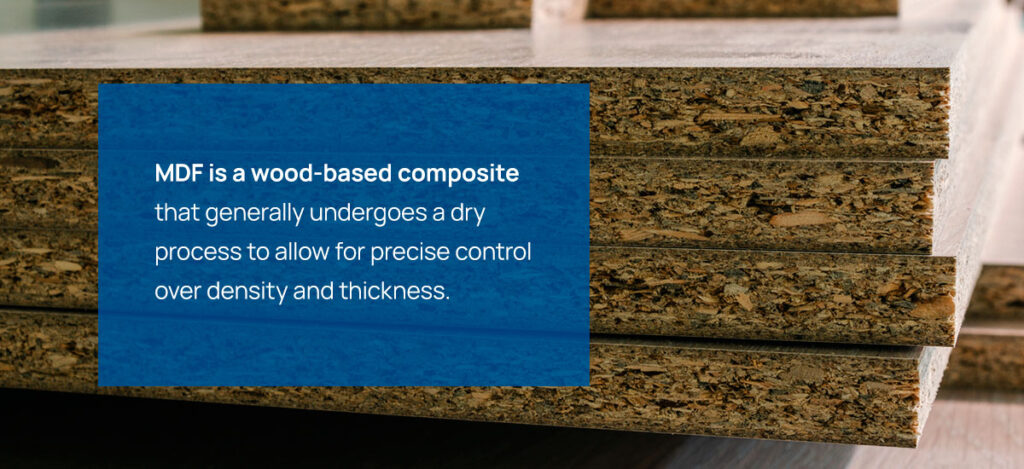
According to the United States Department of Agriculture (USDA), MDF is a wood-based composite that generally undergoes a dry process to allow for precise control over density and thickness. The process begins with sourcing wood fibers from wood chips, roundwood or sawmill fibers. These materials undergo pressurized refining, and then resin is applied to the fibers.
After the fibers dry, manufacturers can press them under heat and pressure to create panels with the desired density and thickness. The manufacturing process includes:
Wood chip delivery and preparation: In most cases, chipping operations, plywood plants or sawmills will deliver the wood material to the manufacturer. If wood chip preparation is on-site, teams must cut wood into manageable lengths and place the material into chippers. Some facilities may need to wash the chips to remove debris.
Material refinement: The wood chips are then placed in a steam-pressurized digester, where they are softened. Then, they are put into a refiner chamber, where revolving disks pulp the softened chips into wood fiber material that can be used to manufacture the board.
Drying: Next, the fibers move to a drying area. Tube dryers reduce the fiber’s moisture content to the necessary levels. Many manufacturers utilize single or multistage drying systems.
Blending: The order of drying and blending operations depends on the method used to blend resins and other additives. Urea-formaldehyde resins are most common in MDF manufacturing, but some manufacturers also use melamine resins, isocyanates and phenolic resins.
Mat forming: The resinated fibers then move from the storage bin to a forming machine. In the forming machine, the resinated fibers will move through a screen system that moves continuously and requires pre-pressing before the mat can move to the hot press. The mat also undergoes pre-trimming, and any trimmed material will be sent back to the forming machine.
Hot pressing: Pre-pressed and trimmed mats move to a hot press. The press applies pressure and heat to activate the resin, allowing it to bond to the wood fibers. This process creates a solid panel.
Product preparation: After the pressing process, the panels will cool before a team sands and trims them. At this point, manufacturers can saw the panels to their final dimensions and apply paint or laminate. Once complete, the finished MDF product can be sent to distributors and contractors for the manufacture of various wood products.
MDF Doors Pros and Cons for Commercial Use
Choosing the right door material is a critical decision for any commercial project, impacting everything from installation efficiency to long-term performance. MDF doors have become a go-to option for many applications due to their engineered composition and adaptability. However, like any building material, MDF doors come with their own set of strengths and limitations. Understanding the pros and cons is essential for distributors and contractors aiming to deliver the best solutions for their clients.
Benefits of MDF Doors
MDF doors empower distributors and contractors to balance performance, aesthetics and value. These doors are engineered for reliability and versatility, allowing them to meet the evolving needs of both residential and commercial projects.
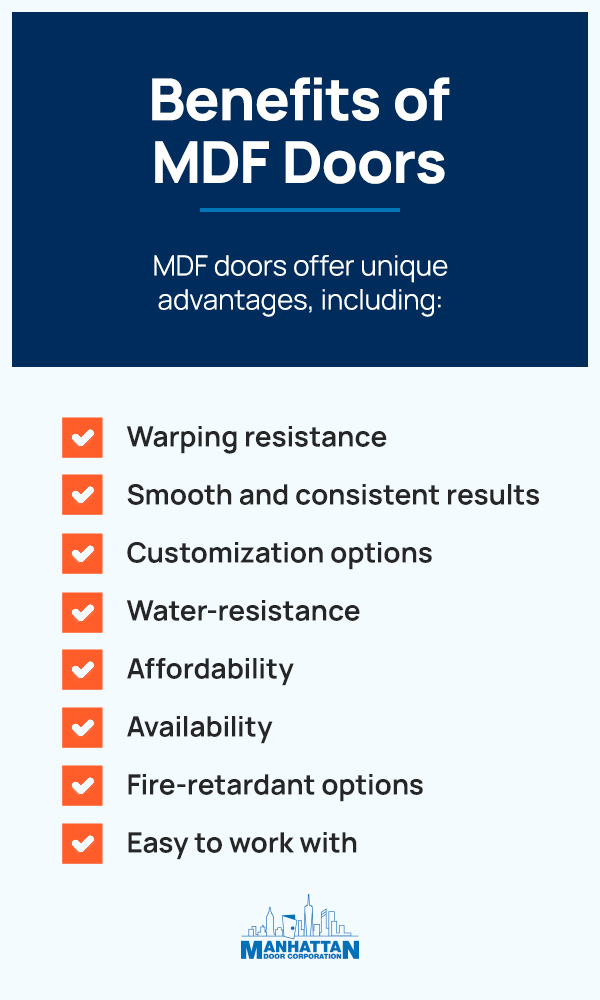
MDF doors offer unique advantages, including:
Warping resistance: Solid wood doors are vulnerable to heat and cold, and humidity and temperature can negatively affect wood, often causing warping. Alternatively, the structure of MDF allows the materials to move as a unit, preventing warping even when the temperature or humidity is extreme.
Smooth and consistent results: MDF board consists of extremely fine particles, resulting in a uniform texture with no noticeable grain. The result is a better, smoother finish, especially with finishes like paint. If your customers want to paint their doors, recommend MDF options over solid wood doors.
Customization options: Manufacturers can drill and cut MDF boards in various ways without causing damage. This flexibility allows you to easily customize products and meet each customer’s aesthetic and functional needs. MDF doors also come in larger sizes. For customers who need a big piece of wood without joints, MDF is often the best option.
Water-resistance: Moisture is a common issue for solid wood doors, and vulnerable wood can attract mold and other unsightly and unsafe hazards. On the other hand, MDF doors can be designed for moisture resistance. These designs make MDF doors suitable for bathrooms and other environments with high moisture levels.
Affordability: With MDF doors, homeowners can get the strength and longevity of a solid wood door at a lower price. Many of the most popular wood species, such as walnut, cherry and white oak, are considerably expensive, and scarcer species like mahogany and teak can be extremely costly.
Availability: MDF doors offer several advantages in terms of supply chain and manufacturing over solid wood doors. MDF can be manufactured from a wide range of wood sources, making the raw material less susceptible to fluctuations in availability. The manufacturing process is also highly scalable, enabling the production of large volumes of panels quickly and efficiently. This supports a steady, high-volume supply to meet market demand.
Fire-retardant options: You can also find fire-retardant MDF doors. This door type is commonly found in commercial buildings, but some homeowners can find peace of mind by installing fire-retardant doors in areas such as kitchens and bedrooms for enhanced fire protection.
Easy to work with: As MDF is made from wood byproducts, contractors will have no trouble cutting, routing or drilling it with their regular woodworking tools. It is also possible to fasten MDF parts together using a wide variety of screws or nails. You can also glue MDF pieces together with nearly any adhesive type.
Disadvantages to Be Aware of
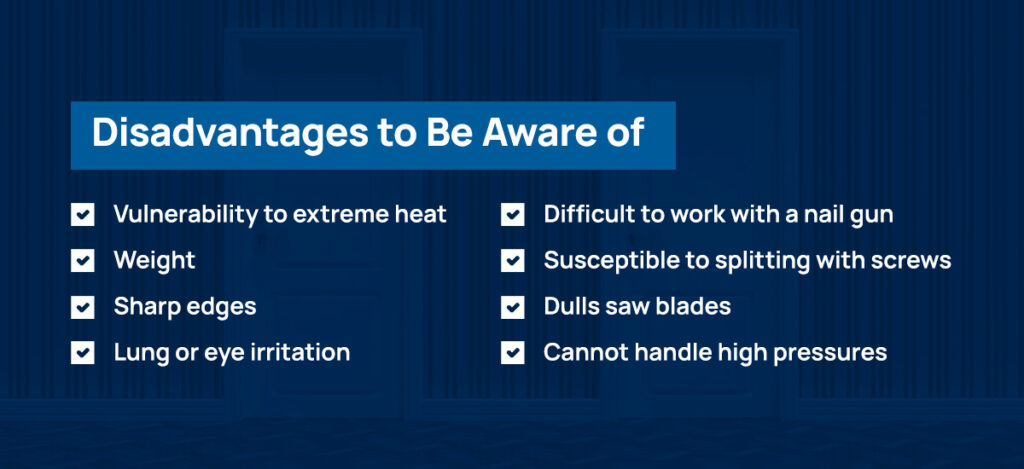
Despite the numerous benefits they offer, MDF doors may not be suitable for all applications. It is important to understand MDF’s downsides and limitations, so you can disclose the necessary information to customers. Cons to be aware of include:
Vulnerability to extreme heat: MDF doors leverage resin and wax-like compounds. While the door will not warp under higher temperatures, these compounds can be damaged by extreme heat. MDF door installation should not occur near fireplaces, radiators, stoves or heaters.
Weight: MDF is significantly heavier than plywood, so care should be taken when transporting or lifting MDF boards. Its density makes it challenging to handle, cut, sand and install.
Sharp edges: The edges of MDF sheets are very sharp and may slice into fingers if handlers are not careful. Customers who handle MDF should wear gloves to prevent injury.
Lung or eye irritation: The manufacturing process leverages formaldehyde, which can be harmful in dust form. After cutting MDF boards, workers could experience eye irritation or lung problems if they are not wearing the appropriate gear. Contractors should wear a dust mask or dual-cartridge respirator when working with MDF and complete operations in well-ventilated areas.
Difficult to work with a nail gun: If fastening MDF with a nail gun, there is a good chance the surface will pucker, which leaves a tiny, raised nib at the location of each nail. However, you can remove these protrusions with a chisel or sandpaper.
Susceptible to splitting with screws: Splitting can result when trying to drive a screw into the edge of an MDF panel door. Driving pilot holes into the panel first can prevent this from occurring. Contractors should also first drill a counter-bore hole if driving a screw into the board face.
Dulls saw blades: Due to MDF’s high glue content, cutting this material will dull saw blades faster than cutting actual wood. To make sure cuts are clean and blades are not quickly dulled, customers should use blades that are high-quality and carbide-tipped.
Cannot handle high pressures: MDF does not have the same strength as natural wood, and when under pressure, it will split or crack. Its lifespan is also not as long as that of real wood.
MDF vs. Solid Core Interior Doors
MDF and solid core doors are two of the most popular types of wood doors. Solid core doors generally feature an exterior skin made of molded composite or plywood. On the inside, they feature a wood fiber blend that makes them feel similar to a door made of solid wood. Solid core doors are considered more durable than hollow core counterparts and provide more noise reduction and temperature insulation.
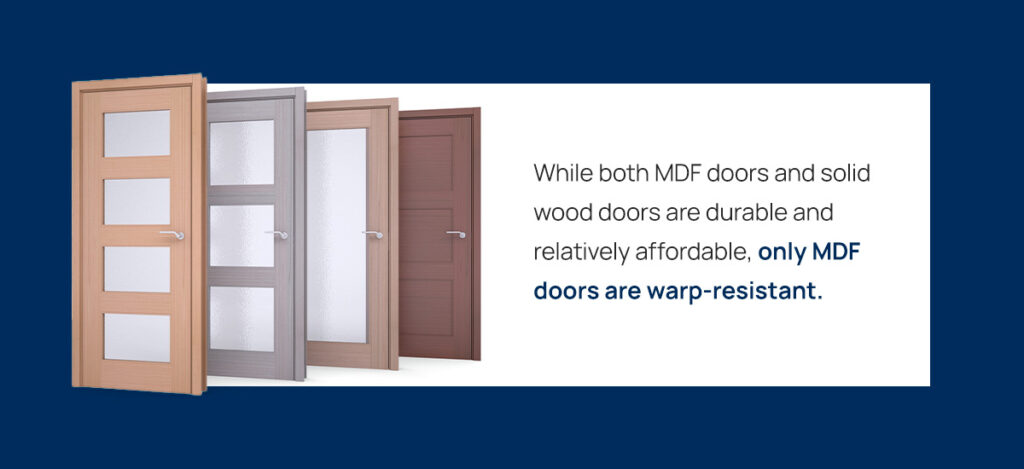
MDF doors are an engineered wood product. They have become a much more popular option for interior doors in recent years. While both MDF doors and solid wood doors are durable and relatively affordable, only MDF doors are warp-resistant. For customers seeking a door that offers excellent sound and temperature insulation, MDF doors are a viable option to consider. MDF doors feature a smooth, beautiful finish that can be easily painted. MDF doors are also more environmentally friendly because they are made from leftover wood products and sustainable materials.
Solid Core MDF Doors: Cores, Thicknesses and Ratings
Solid core MDF doors are engineered for durability, sound control and fire safety in high-traffic environments. Most solid core MDF doors are available in 1-3/8″ and 1-3/4″ thicknesses, with 1-3/4″ being the commercial standard for enhanced strength and fire performance. Some manufacturers offer custom thicknesses to meet specific project requirements.
Solid core MDF doors typically have a core of engineered wood or mineral deposit, which provides weight, stability and sound attenuation. Engineered stiles and rails resist bowing and warping and provide a secure anchor for hinges and hardware. The door faces are smooth, fine MDF for easy machining and paint finishing. Profile designs are available in flush, panel or custom-milled styles to suit various functional and architectural needs.
Solid core MDF doors are also compatible with standard commercial hardware. Factory pre-hanging is available, with precise mortising for hinges and lock sets. Solid wood or engineered edge strips are often used to reinforce hinge and lock areas, ensuring secure fastening and long-term durability.
Understanding MDF Door Fire Ratings
Fire-rated doors utilize unique features and a specialized material composition to slow or prevent the spread of fire and smoke. There are several types of fire-rated doors, with fire ratings often indicated by the length of time a door can resist fire, typically between 20 and 180 minutes. Lower fire ratings are suitable for residential or light commercial applications, while higher ratings are necessary for high-occupancy areas and fire doors.
Fire rating requirements vary by application, and local and federal regulations determine industry standards. However, there are some general requirements for fire doors, regardless of location. For example, all fire doors must have an attached label, be self-closing, have listed hardware and have steel bearing hinges.
Additionally, commercial businesses are required to have fire doors, although the number and location of these doors can vary by municipality. Contractors should always consult manufacturer specifications and local building codes to ensure the correct door type, thickness and fire rating for each project.
MDF Door Soundproof Considerations
Soundproof doors, also known as acoustic doors, can effectively reduce sound. When specifying solid-core MDF doors for interior use, it is essential to understand their sound transmission performance. Several key factors affect sound control:
Perimeter seals: Gaps around the door are the biggest weak point for sound leakage. Properly installed perimeter seals and door sweeps are essential to maximize the door’s acoustic performance.
Thresholds: A well-fitted threshold or drop seal at the bottom of the door helps block sound transmission, especially in high-traffic or noise-sensitive areas.
Installation quality: Even the best door will underperform if not installed tightly within the frame. Proper installation ensures the door closes snugly against all seals.
The industry standard for measuring this is the Sound Transmission Class (STC) rating, which quantifies how well a door assembly reduces airborne sound. STC ratings range from 20 to 60, with the highest ratings making loud noises sound very faint. Most standard commercial environments can benefit from STC ratings above 25, as doors at this level control against everyday office noises.
If your project requires higher levels of sound privacy, such as for conference rooms, medical offices or recording studios, look for doors and frames specifically tested and rated for higher STC values, typically STC 40 or higher. These assemblies may include additional mass, specialized cores or double seals.
MDF Environmental Friendliness
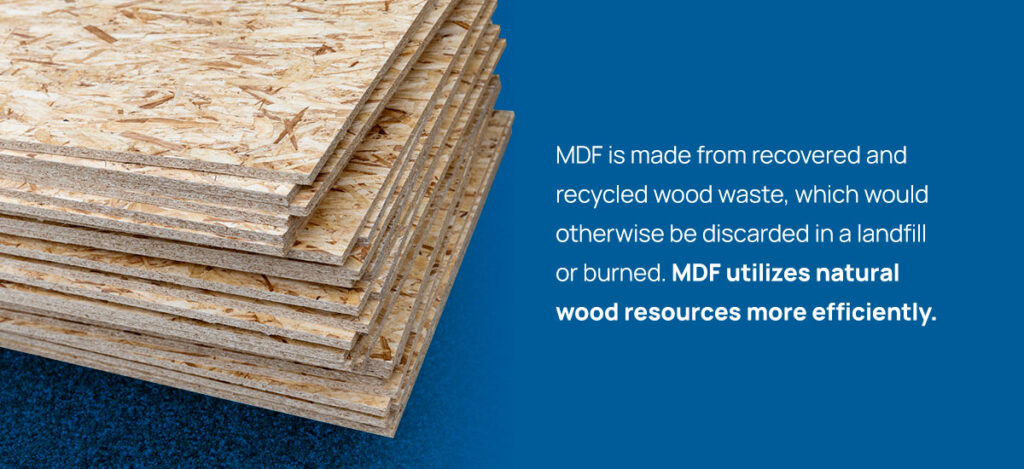
Purchasing MDF doors is an environmentally friendly decision. MDF is made from recovered and recycled wood waste, which would otherwise be discarded in a landfill or burned. MDF utilizes natural wood resources more efficiently.
Some other reasons that MDF is environmentally friendly include:
MDF has a lower environmental impact: Wood products require less energy to manufacture than most other building products. They do not create as many environmentally harmful byproducts and can be recycled or reused. They also have a lower environmental impact over the course of their life.
MDF is biodegradable and renewable: MDF, like all wood products, is 100% biodegradable once its service life is over. It comes from a natural source that is 100% renewable and sustainable. This is not true of concrete, plastic or metal.
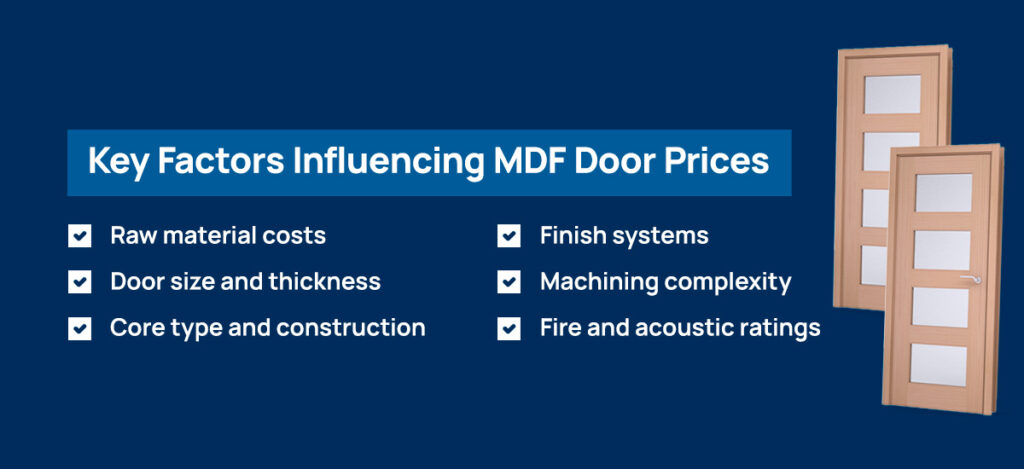
Key Factors Influencing MDF Door Prices
There are a number of options for contractors and their clients when it comes to the wood product they choose for their interior doors. If a buyer has a budget, price will likely be a major factor. Check out key cost drivers for MDF doors below:
Raw material costs: The price of the MDF panels will be a prime factor in pricing. Wood supply fluctuations and resin prices will impact totals.
Door size and thickness: Larger and thicker doors are heavier and require more material, which drives up costs. Custom sizes and non-standard thicknesses will also likely increase expenses.
Core type and construction: Solid core doors offer better performance than hollow core doors and leverage more material. Specialty cores will also increase the overall price.
Finish systems: Prefinished, primed or specialty finishes, such as veneers or laminates, increase manufacturing costs. Custom colors or textures also add to the price.
Machining complexity: Factory prep for hinges, lock sets, lites or custom hardware requires additional labor and precision, raising costs. More complex machining for vision panels or custom cutouts further increases prices.
Fire and acoustic ratings: Doors with certified fire or acoustic ratings require specialized cores, seals and testing, which add to both material and certification costs.
Finishes and Paint-Grade Performance: Primed MDF Best Practices
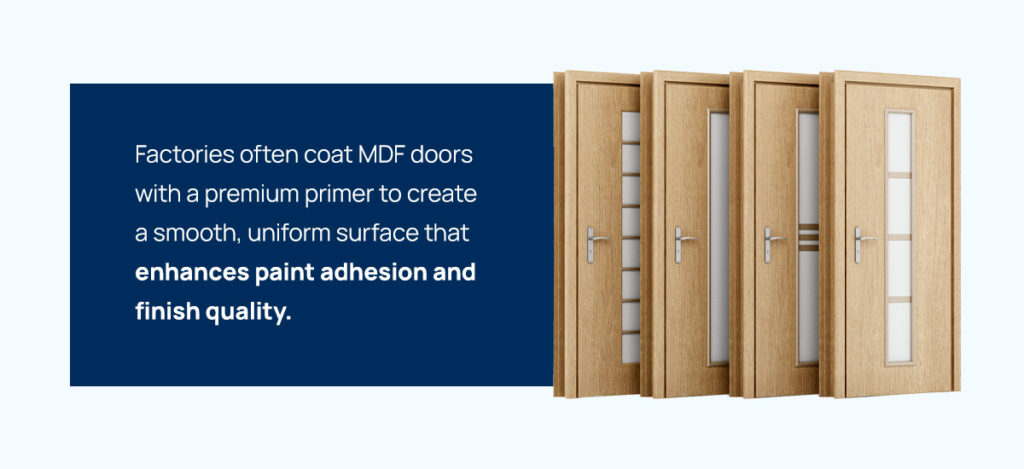
Factories often coat MDF doors with a premium primer to create a smooth, uniform surface that enhances paint adhesion and finish quality. Factory priming can save time on-site and protect the doors from moisture and damage.
For optimal results, it is essential to apply a topcoat of paint immediately after installation. Delaying the topcoat can leave the primer vulnerable to environmental exposure, which may affect long-term finish performance. Primed MDF doors are designed for interior use, and you should take steps to protect the doors from excessive humidity, direct sunlight and temperature extremes.
During handling and storage, keep doors flat, elevated off the floor, and covered to prevent contact with dust and moisture. Avoid storing doors in damp or unconditioned spaces. Before project turnover, inspect all doors for scuffs or scratches and perform touch-ups with compatible primer and finish paint as needed. Prompt touch-ups and proper storage ensure a flawless, professional appearance at project completion.
Frequently Asked Questions About MDF Doors
Explore commonly asked questions about MDF interior doors below:
Are MDF interior doors solid core? You can find MDF doors available in solid core and hollow core options.
Do MDF doors reduce noise? Solid core MDF doors offer moderate sound reduction. For higher sound privacy, consider specialized acoustic doors with enhanced cores and STC ratings of 40 and above.
Are MDF doors good for offices? Yes, MDF doors are a popular choice for offices due to their design flexibility and reliable performance. Solid core doors also offer good sound control, making them suitable for meeting rooms and private offices.
What affects MDF door prices? The key price drivers for MDF doors include raw material costs, door size and thickness, core type, finish options and fire or acoustic ratings. Customization, shipping logistics and order volume can also impact final costs for distributors.
Are MDF doors fire-rated? MDF doors can be fire-rated. Core construction and certification will specify fire ratings, typically ranging between 20 and 90 minutes. Always verify the door assembly meets the required fire codes for each project.
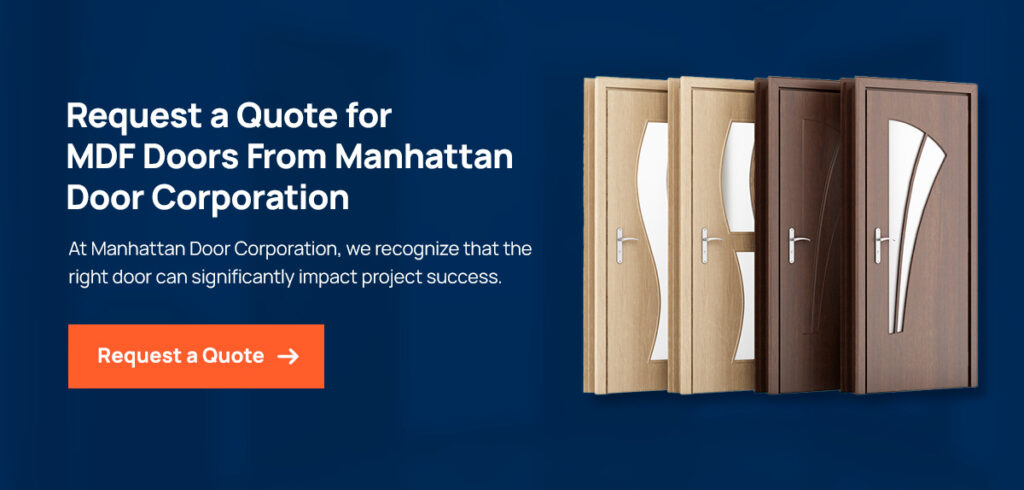
Request a Quote for MDF Doors From Manhattan Door Corporation
At Manhattan Door Corporation, we recognize that the right door can significantly impact project success. Our team helps clients find cost-effective interior wood doors for any application. With more than eight decades of industry experience, we have the knowledge and skills to help you find the right fit. Our custom interior wood doors can meet your needs and budget.
Ready to discuss project needs? Request a quote to get started.